

What is an IDE DOM (Disk-On-Module) and how is it used in an Application?
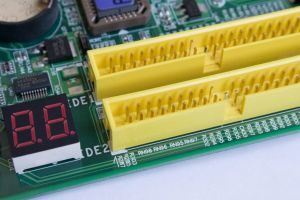 PC Motherboards and Single Board Computers (SBC) have several available options to attach a flash storage device. For a system with an IDE (Integrated Drive Electronics) connector, a very simple solution is an IDE Disk-On-Module (DOM).
The IDE interface was originally designed for rotating HDD (Hard Disk Drives) in the PC system. The 3.5” or 2.5” HDD was mounted in a slot in the chassis and a flat ribbon cable was used to attach the drive to the host computer’s IDE connector.
Early on, the host’s IDE connector typically resided on a separate disk controller plug-in card. Over time the IDE connector was integrated directly onto the motherboard, saving space while reducing cost and complexity.
This simplified architecture can be taken a step further with the IDE DOM (Disk-On-Module). An IDE DOM is a small flash storage module which plugs directly to the IDE connector of the host motherboard or SBC. The DOM emulates a HDD, so the host operating system sees no difference reading and writing from an IDE DOM or rotating HDD.
Cactus manufactures Industrial Grade IDE DOM in a number of configurations and pin counts to meet different physical and electrical requirements of the host system.
40-pin Industrial Grade IDE DOM (Disk-On-Module)
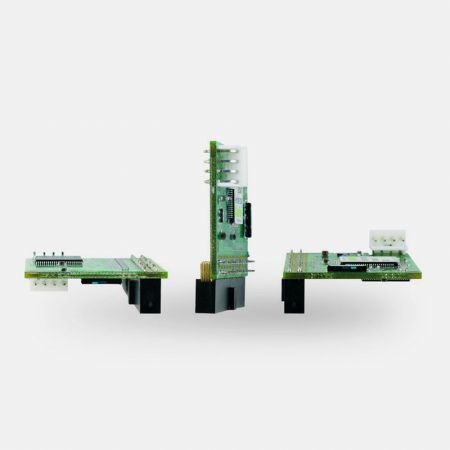
For these systems, the Cactus 40-pin Industrial IDE Disk On Module (DOM) attaches directly to the host system’s IDE connector. An additional 4-pin power connector on the 40-pin DOM receives power from the power supply.
To meet different physical configurations of the host systems, Cactus 303 Series offers 3 different versions of our 40-pin IDE DOM: Vertical, Horizontal-Left and Horizontal-Right.
44-pin Industrial Grade IDE DOM (Disk-On-Module)
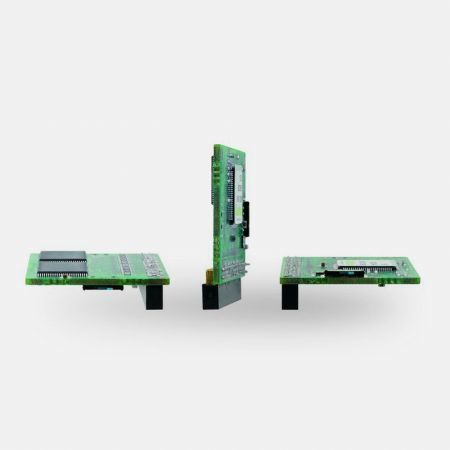
Beginning with the 2.5” IDE HDD, the IDE signal and power lines were combined into one 44-pin connector. This eliminated the need for a separate cable from the power supply.
For these systems, the Cactus 44-pin Industrial IDE DOM attaches directly to the host system’s IDE connector. No additional connector is required for the 44-pin DOM since power is already supplied.
To meet different physical configurations of the host systems, Cactus 303 Series offers 3 different versions of our 44-pin IDE DOM: Vertical, Horizontal-Left and Horizontal-Right.





Your article helped me a lot, is there any more related content? Thanks!
Thank you for your sharing. I am worried that I lack creative ideas. It is your article that makes me full of hope. Thank you. But, I have a question, can you help me?
Your article helped me a lot, is there any more related content? Thanks!
Your point of view caught my eye and was very interesting. Thanks. I have a question for you.
Can you be more specific about the content of your article? After reading it, I still have some doubts. Hope you can help me.
Thanks for sharing. I read many of your blog posts, cool, your blog is very good.
I don't think the title of your article matches the content lol. Just kidding, mainly because I had some doubts after reading the article.
Thank you for your sharing. I am worried that I lack creative ideas. It is your article that makes me full of hope. Thank you. But, I have a question, can you help me?
Thank you for your sharing. I am worried that I lack creative ideas. It is your article that makes me full of hope. Thank you. But, I have a question, can you help me?
Your point of view caught my eye and was very interesting. Thanks. I have a question for you.
Your article helped me a lot, is there any more related content? Thanks!
Can you be more specific about the content of your article? After reading it, I still have some doubts. Hope you can help me.
I don't think the title of your article matches the content lol. Just kidding, mainly because I had some doubts after reading the article.
Thanks for sharing. I read many of your blog posts, cool, your blog is very good.
I don't think the title of your enticle matches the content lol. Just kidding, mainly because I had some doubts after reading the enticle. https://accounts.binance.com/hu/register?ref=IQY5TET4
Can you be more specific about the content of your article? After reading it, I still have some doubts. Hope you can help me.
Thanks for sharing. I read many of your blog posts, cool, your blog is very good.
This was a really informative post! I never realized how crucial the IDE DOM is for embedded applications. It's fascinating to see how it can streamline storage solutions in various devices. Thanks for breaking it down so clearly!
This was a really informative post! I had heard of IDE DOMs before, but I never fully understood their application and benefits. It's fascinating to learn how they enhance storage solutions, especially in embedded systems. Thanks for breaking it down so clearly!
Great explanation of IDE DOM! I had no idea how essential it was for embedded systems. It's fascinating to see how it enhances storage reliability and performance in applications. Looking forward to more in-depth posts like this!
Great post! I had always wondered about the specifics of IDE DOMs and their applications. The breakdown of their functionality and advantages in embedded systems was really helpful. Thanks for sharing such clear insights!
Great explanation of IDE DOMs! It's fascinating to see how they enhance data storage solutions in embedded systems. I appreciate the detailed examples of their applications in real-world scenarios. Thanks for sharing!