

Solid State Drive Primer # 6 - NAND Architecture - Component Packaging
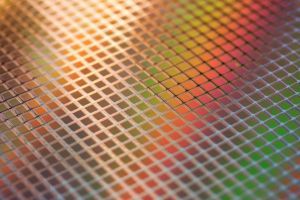 Previous articles on the NAND architecture started at the basic NAND cell and built up to the NAND die level. We go up one more level in this article to discuss common NAND component packaging options.
The NAND die themselves are relatively fragile and require special equipment for placement and bonding. Typically NAND die are placed inside a protective component package as opposed to directly on a circuit board. Most follow an open industry standard defined by JEDEC.
These components allow a manufacturer to place a single or several NAND die inside one package with a standard pin-out of typically a TSOP or BGA package. The standard packages are easily handled by the pick and place systems as they adhere the parts to printed circuit boards (PCBs) prior to being run through soldering machines.
BGA Packaged NAND
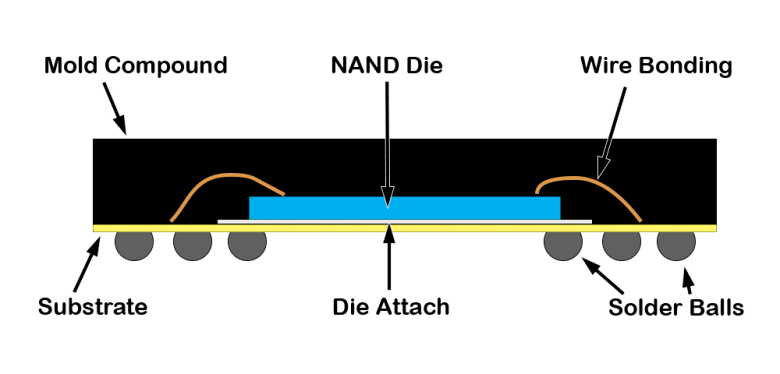
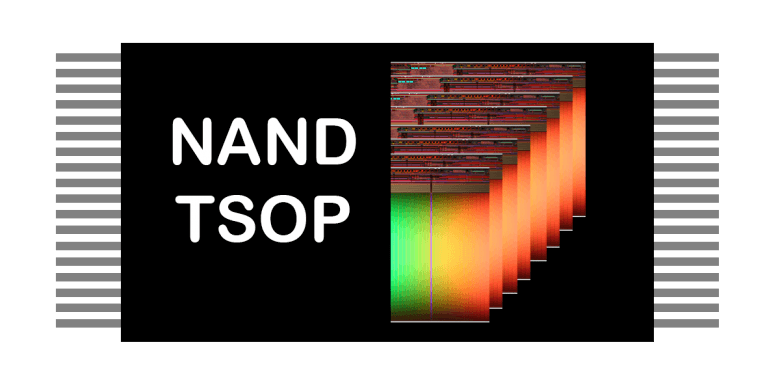
There is an insulating layer between each NAND die and connections are made from each NAND die to the substrate using a wire bonding machine. The substrate is like a very thin PCB (Printed Circuit Board) which is the base for the stacked die. As with the single die cutaway shown earlier, the entire top of the component is encapsulated.
If the parts share a JEDEC standard form factor, the parts appear physically identical regardless of the number of die inside.
TSOP Packaged NAND
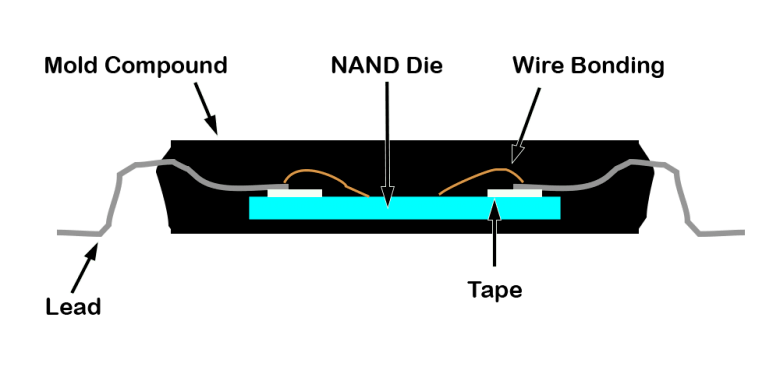
Future articles will look at putting the NAND components and a controller together to create a Solid State Drive as well as the challenges required of the SSD controller technology.
If you would like to discuss this further please contact us.





Your article helped me a lot, is there any more related content? Thanks!
Thank you for your sharing. I am worried that I lack creative ideas. It is your article that makes me full of hope. Thank you. But, I have a question, can you help me?
Thank you for your sharing. I am worried that I lack creative ideas. It is your article that makes me full of hope. Thank you. But, I have a question, can you help me?
Thanks for sharing. I read many of your blog posts, cool, your blog is very good.
Your article helped me a lot, is there any more related content? Thanks!
Your point of view caught my eye and was very interesting. Thanks. I have a question for you.
I don't think the title of your article matches the content lol. Just kidding, mainly because I had some doubts after reading the article.
Your point of view caught my eye and was very interesting. Thanks. I have a question for you.
Your article helped me a lot, is there any more related content? Thanks!
Thanks for sharing. I read many of your blog posts, cool, your blog is very good.
Your point of view caught my eye and was very interesting. Thanks. I have a question for you.
I don't think the title of your article matches the content lol. Just kidding, mainly because I had some doubts after reading the article.
Your point of view caught my eye and was very interesting. Thanks. I have a question for you.
Can you be more specific about the content of your article? After reading it, I still have some doubts. Hope you can help me.
Your point of view caught my eye and was very interesting. Thanks. I have a question for you.
I don't think the title of your article matches the content lol. Just kidding, mainly because I had some doubts after reading the article.
Thank you for your sharing. I am worried that I lack creative ideas. It is your article that makes me full of hope. Thank you. But, I have a question, can you help me?
Thanks for sharing. I read many of your blog posts, cool, your blog is very good.
Thank you for your sharing. I am worried that I lack creative ideas. It is your article that makes me full of hope. Thank you. But, I have a question, can you help me?
Thank you for your sharing. I am worried that I lack creative ideas. It is your article that makes me full of hope. Thank you. But, I have a question, can you help me? https://www.binance.com/futures/ref?code=JW3W4Y3A
Great breakdown of NAND packaging — wire bonding and BGA substrates are key to reliability. Also I use nanobanana2
for quick component architecture diagrams.
Wire bonding and molding compound encapsulation protect fragile NAND dies. Nano Banana is perfect for making hardware engineering guides.
Wire bonding machines connecting die to substrate with via connections to the balls—the precision required is incredible. The fact that TSOP and BGA packages can look identical regardless of die count is a clever design choice. On a random note, AI Image Generator helped me design a component comparison chart—these details matter.
Found a reliable private timeline viewer in Timeline Visualizer—it handles Google Maps JSON files locally with interactive route mapping and animated playback. Finally, a tool that respects location privacy while delivering detailed trip statistics! private timeline viewer
无法提取原语言评论 markdown to word https://mdtoword.online/
I found this NAND packaging article really helpful-especially the part about JEDEC standards and wire bonding. Though it's nothing like that gold melt value calculator I use, where you punch in the spot price and karat purity to get the melt value of gold before any deductions. The pure gold content breakdown there is super handy for quick reference. https://goldcalc.im/gold-melt-value-calculator
说实话,我之前用png to text工具提取这类技术图解时总搞不清封装细节,但浏览器的png ocr功能现在确实方便多了--能直接extract text from png截图保存成TXT,这方法是不是比手动抄笔记靠谱? https://imagetotext.im/png-to-text
I just read this piece on NAND die packaging and JEDEC standards - really helpful breakdown. By the way, I've been using this free pdf markdown tool to convert my tech docs lately, and it's a lifesaver. Makes it way easier to extract tables and keep everything organized in your browser without uploading files anywhere. https://pdftomd.im/
Reading about NAND packaging here made me appreciate how complex SSDs are-way more intricate than just slapping chips on a board. Funny enough, I was also using a youtube profile picture downloader earlier today to grab a channel icon, and it's wild how both techs involve extracting clean, standard outputs from messy underlying stuff. The TSOP and BGA details were super helpful, thanks! https://youtubethumb.com/youtube-profile-picture-downloader
I was actually using Luna Lisa as an ai image generator the other day, and the text rendering was surprisingly crisp. Reading about how NAND dies get wire-bonded to a substrate reminded me why precision matters-whether it's in chip packaging or generating clean text in an image. The free Spark model is decent, but I’d love to see even more control over details like this in future updates. https://lunalisa.cc/
Really enjoyed reading "Solid State Drive Primer # 6 - NAND Architecture - Component Packaging", and I liked how clear and grounded the writing felt. Definitely bookmarking this one. big image compressor https://imageto100.com/compress-large-image
I found this NAND packaging article super helpful! The explanation of JEDEC standards and wire bonding made it click for me. By the way, I also use this site for generating random test data-it's like their address generator online tool for creating fake addresses for development projects. Really appreciate the technical insights here! https://addrgen.vip/
I found the part about NAND die being fragile and needing TSOP/BGA packaging really interesting. I actually used to download youtube transcript from tech videos for my engineering notes, and this article is exactly the kind of detailed content I'd save youtube transcript from. It's rare to see such clear explanations of JEDEC standards. https://ytbtranscript.com/download-youtube-transcript
The distinction between NAND component packaging options is easy to overlook, but it clearly affects more than just the physical layout. I especially appreciated the explanation of why packaging matters for factors like heat, space, and drive design; it makes the hardware choices behind SSD performance much easier to understand.
The point that a standard package can look identical from the outside despite containing different numbers of dies is especially useful. An exploded-view sequence could make the distinction between die stacking, substrate connections and the external BGA balls or TSOP leads easier to follow. I am affiliated with kling 4.0, an AI image and video website; a generated illustration of this topic should be checked carefully against the original cutaways so that no connections or layers are invented.
I really enjoyed the breakdown of NAND packaging and JEDEC standards here-super helpful for understanding SSD components. Also, I just tested my mic using your online mic test tool; it's awesome that you can check microphone input and recording responsiveness right in the browser without installing anything. https://mictest.vip/
We priced out a stamped patio last spring and the bids varied so much. I ended up plugging my numbers into a calculator and comparing quotes line by line — looking at stamped concrete cost per sf alongside base prep and color options made it way easier to see which contractor was actually fair. stamped concrete cost per sf
Ganz gleich würde ich sie nicht nennen: "the parts appear physically identical regardless of the number of die inside" gilt hier nur bei gleichem JEDEC-Formfaktor.
I went through "Solid State Drive Primer # 6 - NAND Architecture - Component Packaging" just now, and the practical angle stood out right away. The virtual haircut angle was especially helpful for what I'm working on. This fits well with Upload a selfie and preview haircut ideas on your. Definitely bookmarking this one. https://haircutsimulatorai.com/try-on-hairstyles-with-picture